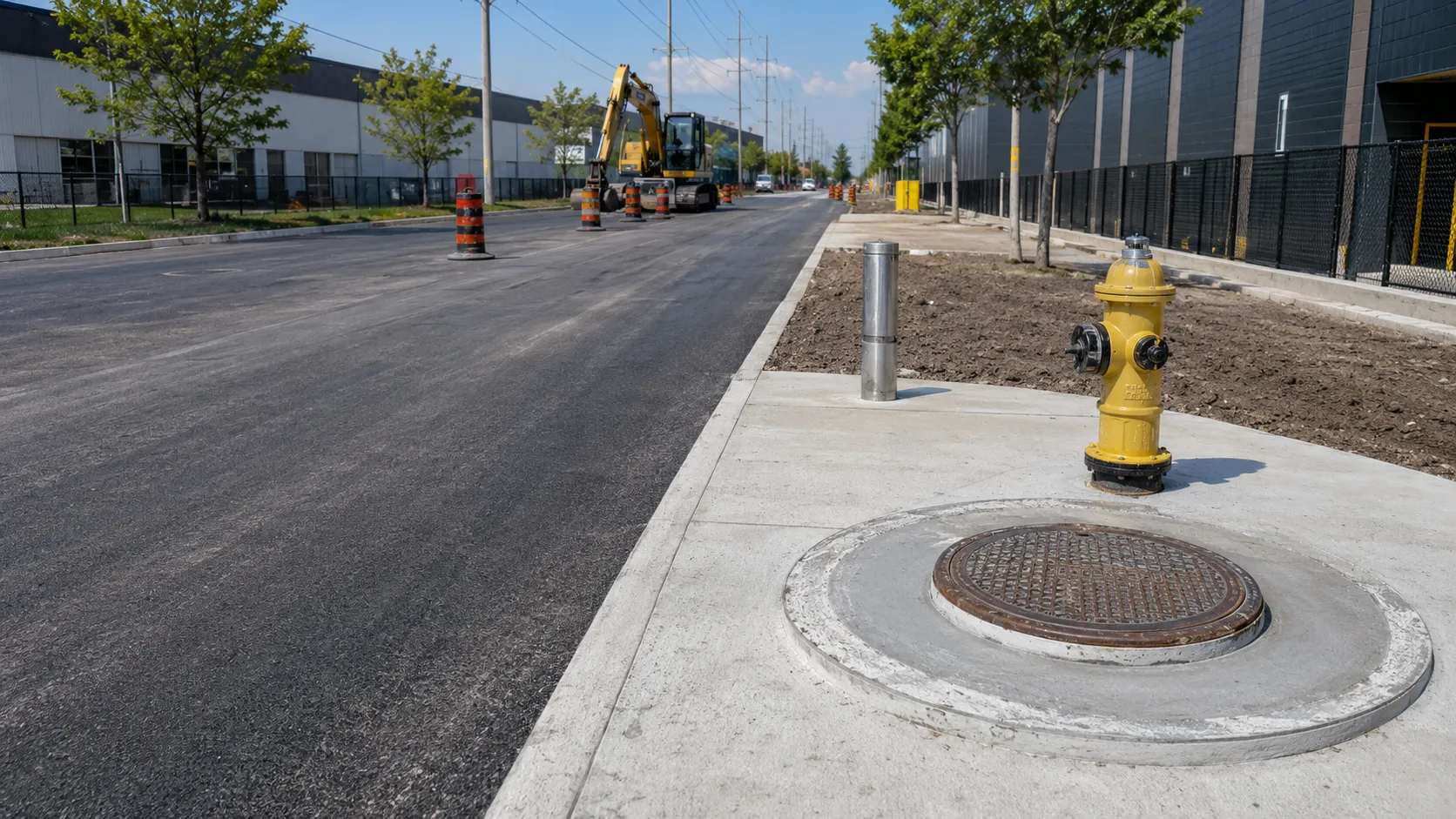
Built to spec
Built to your engineered drawings, survey, and the real site conditions, not a standard package forced to fit.

Harrowgate restores aging sewer and watermain assets for municipalities, developers, industrial sites, and commercial properties. We self-perform trenchless rehabilitation, targeted excavation, flow control, testing, and reinstatement across the GTA and Ontario.
Tell us what you need and we’ll get you a quote. Licensed, insured & WSIB certified · Free, no-obligation quote & on-site assessment.
Licensed, insured & WSIB certified · Free, no-obligation quote & on-site assessment.
Built to your engineered drawings, survey, and the real site conditions, not a standard package forced to fit.
Heavy-duty steel and finishes chosen for the load, traffic, and environment on site.
Send specs, drawings, or photos and get a free, no-obligation site visit and estimate with no guesswork.
Installation and site work completed in accordance with Ontario requirements.
Sewer and watermain rehabilitation renews deteriorated buried infrastructure through condition assessment, cleaning, structural lining, localized repair, corrosion control, and selective replacement. Harrowgate self-performs this work across the GTA, matching each pipe segment to a practical method that restores capacity, controls leakage, and limits excavation around active commercial and municipal sites.


Self-performed on site to the engineered drawings, coordinated with concrete, servicing, and the surrounding work, then a clean, documented finish.
We compare CCTV findings, break history, material, remaining geometry, alignment, hydraulic capacity, groundwater, loading, connections, and access. Rehabilitation is selected when the host corridor and design can support a dependable renewal. Collapse, severe sag, widespread joint failure, inadequate diameter, or unrecoverable alignment usually directs the work toward targeted or complete replacement.
Yes. CIPP, close-fit lining, spot repair, cement mortar lining, cathodic protection, and other trenchless methods use maintenance holes or planned access pits and avoid continuous trenching. Small excavations can still be required for fittings, collapsed sections, reconnections, valves, liner insertion, sampling, or geometry that rehabilitation equipment cannot pass.
For sewers, we establish flow control with plugs, pumps, monitored discharge piping, and standby capacity sized to the operating risk. For watermains, we install and test an approved temporary potable-water system and coordinate hydrants and critical users before isolation. The specific arrangement follows owner requirements, site demand, and the planned shutdown window.
We record the initial condition, clean and mechanically prepare the reach, then complete a pre-installation inspection that confirms the bore, connections, and measured design conditions. After rehabilitation and connection reinstatement, final CCTV documents the complete asset, verifies an unobstructed bore, records defects, and identifies any item requiring correction before acceptance.
Internal corrosion creates tubercles and deposits that narrow the bore, increase friction, trap sediment, and can affect water appearance. Cleaning removes loose corrosion products and deposits. Where the remaining pipe is suitable, a smooth cement mortar or engineered liner isolates the interior surface and restores a more effective hydraulic passage.
Provide plan and profile drawings, pipe size and material, installation year if known, break and blockage history, CCTV or leak records, valve and maintenance hole data, flow or pressure information, operating restrictions, traffic constraints, and restoration expectations. We use those records to target field verification and define a comparable construction scope.
Yes, when the selected system spans and seals the actual leakage path. Mainline liners, service lateral liners, connection liners, grout, maintenance hole rehabilitation, and localized repairs address different entry points. We inspect the main, connection, and lateral separately because lining the main alone does not automatically seal groundwater entering around an unrehabilitated connection.
Requirements depend on ownership and asset type. Municipal specifications govern construction and acceptance, OPSS provisions cover relevant civil work, Ontario drinking-water rules control potable systems, and Ontario guidance addresses sewer design and separation from watermains. Project drawings and special provisions remain the controlling documents for each installation.
Commercial and heavy-civil construction, self-performed for developers, contractors, property managers, and municipalities.
Send drawings, a site plan, or a description of the scope. Harrowgate Group is licensed, insured, and WSIB certified.
Licensed, Insured & WSIB Certified · Self-performed and documented on every job
Tell us what you need and we’ll get you a quote. Licensed, insured & WSIB certified · Free, no-obligation quote & on-site assessment.
Harrowgate Group provides sewer and watermain rehabilitation, delivered and installed with quote-ready support across Toronto and surrounding Ontario communities.
Companies We've Worked With
Harrowgate Group delivers commercial and heavy-civil construction for developers, contractors, institutions, municipalities, and property groups across Ontario.
 Popeyes
  Tim Hortons
  Subway
  University of Toronto
  Madison Group
  RioCan
  Women's College Hospital
  Starbucks
  Mazda
Mazda  TD Bank
  City of Toronto Popeyes Tim Hortons Subway University of Toronto Madison Group RioCan Women's College Hospital Starbucks Mazda TD Bank City of Toronto